
Choosing a Wall Cladding Wpc Wall Panel in 2026 requires more than comparing colors, textures, and online prices. The right panel must suit the building’s climate, wall structure, moisture exposure, and maintenance expectations. A warm wood grain may look convincing in a showroom, yet perform poorly beside constant rain or strong afternoon sunlight. Ask for verified data on water absorption, dimensional stability, fire performance, UV resistance, and installation tolerances.
Dr. Qingwen Wang, a respected wood-plastic composite materials researcher, offers a useful reminder: “Material performance begins with understanding service conditions, not appearance alone.” That principle should guide every specification. Check the panel’s wood-fiber content, polymer type, surface treatment, fastening system, and warranty terms. Examine a physical sample outdoors, if possible. Notice its texture after rain, its color under direct sunlight, and the behavior of its joints.
Reliable selection also depends on installation details. A quality panel can still fail when ventilation gaps are blocked, expansion space is ignored, or the substrate is uneven. Local temperature changes matter. So does coastal salt air. Some product claims may sound impressive but remain unclear without independent testing. This is where buyers need to pause and question assumptions.
This guide will compare practical selection criteria for residential, commercial, and renovation projects. It will also examine sustainable sourcing, expected service life, cleaning needs, and common installation mistakes. No panel is perfect. The best choice balances appearance, tested performance, budget, and the realities of the project site.
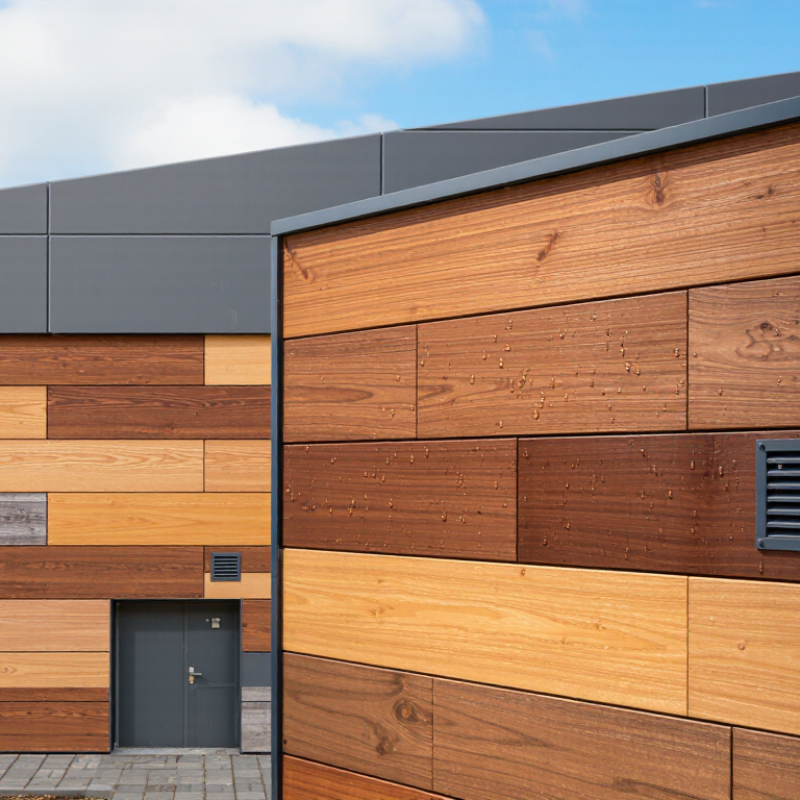
When reviewing WPC wall panels, check the wood fiber percentage before judging color or texture. A panel with 50–60% wood fiber usually balances natural appearance, dimensional stability, and easier processing. The remaining content often includes polymer, pigments, stabilizers, and coupling agents. These ingredients matter too.
Panels with 60–70% wood fiber can feel more wood-like and provide a stiffer surface. They may suit feature walls, sheltered façades, and interiors where visual warmth is important. However, higher fiber content can increase moisture sensitivity if the formulation or edge sealing is weak. Panels near 50% fiber often tolerate production and installation variations better. They can also offer more consistent movement in changing humidity. Not always, though.
I once assumed that more wood fiber automatically meant higher quality. That shortcut was wrong. A well-made 55% panel may outperform a poorly processed 70% panel. Check the technical sheet for density, water absorption, thickness tolerance, and thermal movement. Ask for independent test results when the panels will face rain or strong sunlight. Inspect a cut edge, too. Loose fibers, uneven color, or a strong chemical odor deserve questions. For installation, leave the specified expansion gap and protect exposed ends. Composition is only one part of performance, but it is a useful starting point for comparing wall cladding options in 2026.
Compare representative WPC formulations with 50–70% wood fiber content. Higher wood fiber levels can provide a more natural appearance and greater rigidity, while higher polymer content generally supports moisture resistance and dimensional stability.
The chart uses representative formulation scenarios within commonly reported WPC composition ranges. Actual panel compositions vary by production process, polymer type, additives, and application requirements; always confirm the technical datasheet before selection.
Exterior WPC wall panels face rain, condensation, and repeated drying. Water absorption below 2% is a practical target for exterior cladding, not a universal legal limit. The result must include the test method, exposure time, and specimen condition.
ASTM D570 measures plastics’ water absorption after immersion, while EN 15534-1 evaluates water-related performance in wood-plastic composite profiles. These standards show why percentages need context. A panel reporting 1.8% absorption after 24 hours may perform differently after wet-dry cycling. Ask for both results. Small details matter.
Check the panel edge, not only its smooth face. On site, installers cut panels around windows, leaving exposed composite cores. Seal those cuts carefully, and keep drainage gaps open behind the cladding. A 2023 building-envelope report from the U.S. Department of Energy notes that ventilation and drainage reduce moisture accumulation in rain-screen walls. The panel cannot solve poor detailing.
Request an independent laboratory report showing absorption by mass, thickness swelling, and repeated-cycle performance. Compare results from at least three production batches when possible. A value below 2% sounds precise, but production variation can undermine confidence. I would also inspect a sample after several days of wetting and drying. Laboratory numbers are useful. Real walls remain less obedient.
| Evaluation Dimension | Exterior-Cladding Target | Why It Matters | How to Verify | Selection or Installation Action |
|---|---|---|---|---|
| Water absorption | Below 2.0% by mass for the finished panel | Lower absorption helps reduce swelling, staining, freeze-related damage, and moisture-driven movement. The 2.0% value is a project screening target rather than a universal building-code limit. | Request an independent laboratory report identifying specimen conditioning, immersion time, specimen dimensions, and the test method. ASTM D570 is commonly used for water absorption of plastics. | Reject products that exceed the project limit unless the design has been specifically engineered for the higher absorption level. |
| Absorption calculation | For every 100 g of oven-dry material, water uptake should remain below 2 g. | A mass-based limit makes supplier data easier to compare when panel thicknesses differ. | Water absorption (%) = [(wet mass − dry mass) ÷ dry mass] × 100. | Confirm that the supplier reports the result as a percentage of dry mass, not as a volume increase or an unqualified “waterproof” statement. |
| Thickness swelling | Use the manufacturer’s tested value; set a project limit appropriate to joint width, fastener spacing, and climate exposure. | A panel can have low mass absorption but still experience measurable dimensional change at edges, joints, or cut ends. | Review thickness-swelling results after water immersion and compare them with the planned reveal and movement gap. | Provide movement gaps at panel ends and around openings; do not butt panels tightly together. |
| Linear dimensional change | Obtain tested expansion data for the expected temperature and humidity range. | WPC panels combine polymer and wood-based components, so heat and moisture can affect length, width, and joint alignment. | Ask for thermal expansion and humidity-conditioning data for the actual profile, color, and panel length. | Follow the tested fastener spacing and clearance requirements instead of applying one universal gap to every product. |
| Edge and cut-end protection | All exposed cut edges, penetrations, and end joints must be protected according to the installation specification. | Cut edges may expose more wood-containing material than the factory-finished face and can absorb water faster. | Inspect samples after cutting and review the approved edge-sealing or flashing detail. | Use compatible sealants, end caps, flashings, or backer details; never rely on the face finish alone. |
| Drainage and rear ventilation | Use a drained and ventilated rainscreen arrangement where required by the wall design and local code. | A low-absorption panel does not eliminate water behind the cladding. Drainage and drying reduce the duration of wet exposure. | Check the wall section for a drainage path, bottom outlet, top outlet, insect screening, and unobstructed ventilation openings. | Keep the cladding clear of standing water and maintain the specified cavity depth and opening sizes. |
| Fastener and substructure compatibility | Use corrosion-resistant fasteners and a structurally suitable, aligned substructure. | Moisture, coastal salt, and dissimilar-metal contact can accelerate corrosion and create staining or loss of fixing capacity. | Verify fastener material, coating, pull-out capacity, edge distance, and compatibility with the supporting frame. | Use the tested fixing pattern and avoid overdriving screws, which can restrict movement or damage the panel. |
| Freeze–thaw exposure | Require freeze–thaw or weathering evidence when the project is located in a freezing climate. | Water retained in a porous composite can expand during freezing and contribute to cracking, delamination, or surface deterioration. | Review a documented test program using the applicable project or regional standard and exposure conditions. | Give preference to products with tested performance for the intended freeze–thaw environment, not merely indoor water-resistance data. |
| Surface finish and color | Confirm exterior UV and weathering performance for the selected finish and color. | Color change, chalking, and surface erosion are separate issues from water absorption and may vary by pigment and cap layer. | Request accelerated-weathering data and compare it with the project’s solar exposure and warranty requirements. | Evaluate a physical sample outdoors or under representative lighting before approving the final color. |
| Quality-control documentation | Use batch-level records for water absorption, dimensions, appearance, and production date. | Recycled content, wood-fiber ratio, processing conditions, and surface treatments can affect moisture performance between production batches. | Request a technical data sheet, test report, installation manual, safety information, and batch inspection records. | Approve only panels whose tested profile and composition match the material supplied to the project. |
Note: The below-2% water-absorption value is a practical exterior-cladding selection target. Final acceptance criteria must be coordinated with the project specification, applicable building codes, exposure conditions, and the panel manufacturer’s tested installation system.
When selecting WPC wall panels in 2026, treat fire performance as a design requirement, not a marketing phrase. NFPA reported 1,504,500 fires in the United States during 2023. Building materials can influence flame growth, smoke movement, and evacuation time.
Ask for a current test report covering the exact panel composition. ASTM E84 Class A generally means a flame-spread index of 0–25 and a smoke-developed index of 0–450. It measures surface burning under controlled conditions. It does not prove fire resistance for a complete wall assembly. That distinction matters.
For European projects, review EN 13501-1 classification. Check the reaction-to-fire class, smoke rating, and flaming-droplet rating, such as B-s1,d0. “s1” indicates limited smoke production, while “d0” indicates no flaming droplets. Request reports for the intended thickness, finish, adhesive, and backing system. A different substrate can change performance.
Inspect the installation details, too. Ventilated cavities, open joints, and concealed services may need tested fire barriers. A panel can pass alone yet perform differently on site. I have seen specifications rely on outdated reports. That is a preventable weakness. Keep the test date, laboratory scope, and installation drawings together before approval.
Choosing WPC wall panels in 2026 requires more than comparing colors and surface textures. Installation planning matters just as much. WPC can expand and contract when temperature and humidity change. For this reason, allow an 8–10 mm expansion gap at every panel joint. Keep the same allowance near corners, ceilings, floors, and fixed structures.
Before cutting, measure the wall in several places. Walls are rarely perfectly straight. Check the substrate for moisture, dust, and loose areas. A dry, stable, and level surface helps the panels remain aligned. Use suitable fasteners and avoid tightening them so firmly that the panel cannot move slightly. That small movement is necessary.
I have seen installers reduce the gap because it looked too wide during fitting. That choice often creates pressure later. Panels may bow, separate, or push against the trim.
It is better to hide the gap with compatible profiles than to remove it. Leave ventilation space where the wall system requires it, and follow the panel supplier’s installation data. Do not assume every WPC product reacts identically.
A shaded interior wall and a sun-heated exterior wall need different planning. Test one section first. It may reveal an uneven wall, incorrect fasteners, or a cutting mistake before the whole project is affected.
A 15–25-year service life sounds persuasive, but the number needs evidence. Ask for test reports covering water absorption, color stability, impact resistance, and fire performance. Check whether testing matches your climate and installation method. A panel facing strong sunlight and coastal moisture may age faster than one installed indoors. Experience matters here. Inspect completed projects after several years, not only freshly finished walls.
Calculate total cost across the expected service period. Include panel prices, framing, fasteners, labor, transport, cutting waste, cleaning, repairs, and possible replacement. A lower purchase price can become expensive if boards warp or require frequent repainting. A durable surface may reduce maintenance, but only when drainage and ventilation are designed correctly. Confirm the supplier’s installation guidance and warranty conditions. Some warranties exclude poor substrate preparation or unapproved cleaners.
Use a simple annual-cost comparison. Divide purchase and maintenance expenses by the realistic service years, then add a risk allowance for repairs. Do not treat 25 years as guaranteed. It is an estimate. A spreadsheet can still mislead if labor rates rise or access becomes difficult. Review samples under direct light, inspect edge finishing, and ask installers about expansion gaps. Small details matter. A panel that looks economical today may demand more attention than expected.