
Leave Your Message

What Are the Top Types of Wall Panel Boards?

Choosing a Wall Panel Board is not just a finish decision. The board affects moisture control, fire performance, sound, durability, and installation time. Options range from plywood and oriented strand board to gypsum, cement, MDF, and PVC. Each behaves differently behind paint, tile, or exposed joinery. A board that performs well in a dry bedroom may fail in a damp bathroom. Details matter.

Grand View Research’s 2024 Wall Panels Market Analysis estimated the global market at approximately USD 12.6 billion in 2023, with continued growth projected through 2030. That figure signals broad demand, but it cannot tell a homeowner which board suits a particular wall. For technical context, APA’s Engineered Wood Construction Guide explains how wood structural panels are selected and installed. Building-science expert Joseph Lstiburek offers a useful reminder: “The perfect wall is one that has all the control layers on the exterior of the structure” (Building Science Corporation, “The Perfect Wall”). His point is especially relevant where panel choice meets insulation, water, and air-control details.

This guide compares the leading board types by material, typical use, strengths, and trade-offs. It also considers weight, fastening, surface finish, and exposure to moisture. A neat sample in a showroom can be misleading. The substrate, room conditions, and workmanship matter just as much. And some product claims deserve a second look. The best choice is rarely the most fashionable board; it is the one that fits the wall’s real conditions.
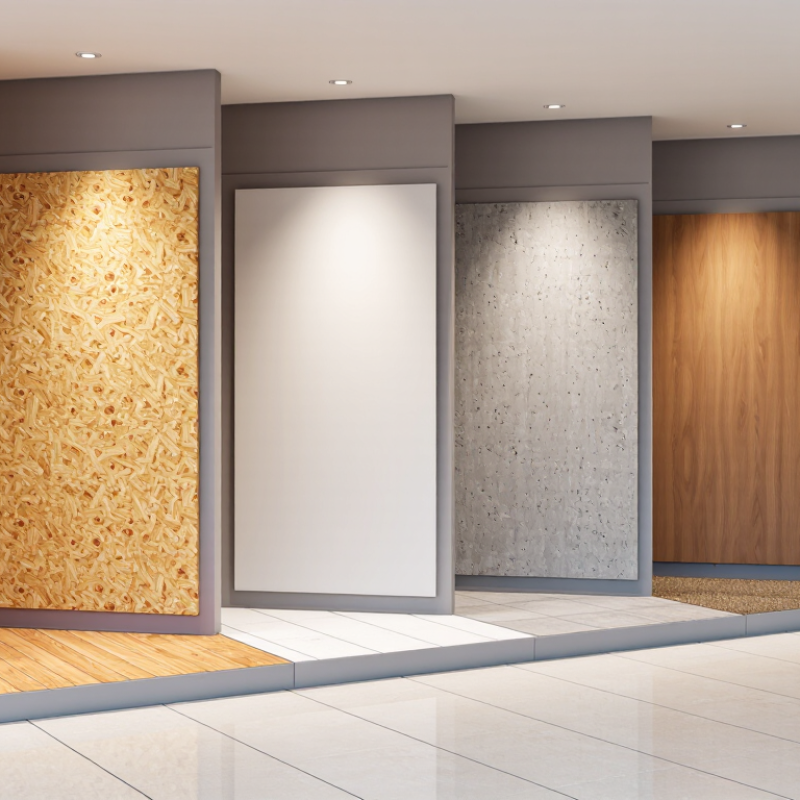
What Are the Top Types of Wall Panel Boards?

Identify the Main Wall Panel Types: MDF, Plywood, PVC, Gypsum, and Cement Board

What Are the Top Types of Wall Panel Boards?

MDF provides a smooth, consistent surface for painted interior panels and decorative grooves. It cuts cleanly, but standard MDF can swell when moisture reaches an unsealed edge.

Plywood is lighter and often holds screws well, making it useful for built-ins or walls that need extra fixing strength. Its layered edges may show, though, and surface quality varies by grade. Check the panel face before buying.

PVC panels resist water and wipe clean, so they suit damp rooms when the product is rated for that use. They can feel less solid than wood-based boards, and heat may affect some products.

Gypsum board is common for flat interior walls and is easy to finish with joint compound. It is not a substitute for waterproofing.

Cement board is heavier and more rigid; installers often use it beneath tile in wet areas, following the panel maker’s fastening and sealing instructions. It can be harder to cut, and dust control matters.

Moisture changes the choice. The right board depends on the room, finish, and how the panel will be fixed. Even a good board can fail if its edges or joints are poorly protected.
Compare Standard Sheet Sizes: A Common 4 × 8 ft Panel Covers 32 sq ft

Wall panel boards are often sold in familiar sheet dimensions, and 4 × 8 ft is a common format. One sheet covers 32 square feet on paper. That is the gross area, not always the finished coverage. Cuts, seams, and damaged edges reduce what you can use. Measure the wall before buying. A 10 × 8 ft wall has 80 square feet, or 2.5 sheets mathematically. In practice, three sheets are usually the minimum, before trimming.

Panel direction affects the cut plan. Vertical sheets may leave narrow offcuts, while horizontal placement can suit a room better. Outlets, windows, and uneven corners complicate the estimate. Measure twice. Plywood, MDF, and gypsum panels may come in the same nominal size, but their thickness, weight, and edge details differ. Check the actual dimensions listed for the board. A small variation can matter when several sheets meet. It is easy to underestimate waste, especially around doors or awkward corners. A quick wall sketch, with openings and seams marked, can help you estimate more reliably. I would still allow some extra material; one misplaced cut can change the whole plan.

Common Wall Panel Sheet Sizes and Coverage

Coverage is calculated from nominal sheet dimensions: width × length. A common 4 × 8 ft panel covers 32 sq ft. Sheet sizes vary by panel type and availability.

Check Fire Performance: ASTM E84 Class A Has a Flame-Spread Index of 0–25

What Are the Top Types of Wall Panel Boards?

Wall panel boards include gypsum, wood, fiber-cement, PVC, and composite panels. Each suits different spaces and installation needs. Gypsum boards are common indoors, while fiber-cement panels can handle damp conditions when installed correctly. Appearance matters, but fire performance deserves equal attention. A convincing surface finish cannot tell you how a panel behaves in a fire.

ASTM E84 measures how a material’s surface contributes to flame spread and smoke development under a controlled test. Class A corresponds to a flame-spread index of 0–25. That is a test result, not a promise that a wall is fireproof. Not fireproof. The rating also does not automatically describe the performance of a complete wall assembly. Substrates, adhesives, joints, and installation details can change how the system performs. Check the product’s test documentation and confirm that the tested configuration matches your planned use. This step is easy to miss, especially when panels look similar on a showroom wall.

Tips: Ask for the ASTM E84 report, not just a “Class A” claim. Check both flame-spread and smoke-developed results, then verify installation requirements. If details are unclear, pause and ask a qualified building professional.

Compare Acoustic Panels Using NRC Ratings on a 0.00–1.00 Scale

Wall panel boards include fabric-wrapped acoustic panels, perforated wood panels, slotted boards, and solid decorative panels. Their appearance can be similar, but sound absorption differs. For a measurable comparison, check the Noise Reduction Coefficient (NRC), commonly shown from 0.00 to 1.00. ASTM C423, the industry reverberation-room test method, calculates NRC from absorption results at 250, 500, 1,000, and 2,000 Hz, rounded to the nearest 0.05. A higher rating generally means more sound energy is absorbed in that test.

A panel rated NRC 0.80 absorbs substantially more sound, on average, than one rated 0.30 under the test conditions. Yet NRC is not a soundproofing score. It does not tell you how well a wall blocks sound traveling between rooms, and it can hide weaker performance at particular frequencies. A thick panel with a small air gap may perform differently from the same panel mounted flat. Real rooms are messy, too; furniture and ceiling height affect what people hear.

Tips: Compare tested NRC data for the exact panel thickness and mounting method. Check the test report, not just a sales-sheet estimate. For speech-focused rooms, also review frequency-specific absorption results, especially around the midrange. One number is useful, but not the whole story.

What Are the Top Types of Wall Panel Boards? - Compare Acoustic Panels Using NRC Ratings on a 0.00–1.00 Scale

Wall panel board type Typical NRC range Typical construction Common applications Key consideration
Fabric-wrapped fiberglass 0.80–1.00 Porous fiberglass core covered with acoustically transparent fabric Offices, classrooms, studios, meeting rooms Thickness and air space behind the panel affect absorption.
Perforated wood or MDF 0.50–0.95 Perforated or slotted facing, usually backed by an absorptive layer and cavity Auditoriums, libraries, offices, public interiors Perforation pattern, backing, and mounting depth make a substantial difference.
PET felt panels 0.30–0.85 Compressed polyester-fiber felt, sometimes layered or spaced off the wall Workspaces, classrooms, collaborative areas Performance varies with thickness, density, and any air gap.
Wood-slat panels with acoustic backing 0.50–0.90 Timber slats over a sound-absorbing felt or mineral-fiber layer Reception areas, conference rooms, residential interiors The backing and open area between slats matter more acoustically than the decorative face alone.
Melamine foam panels 0.70–1.00 Lightweight, open-cell acoustic foam, commonly supplied as tiles or panels Studios, equipment rooms, commercial spaces Check fire, smoke, durability, and cleaning requirements for the intended space.
Standard gypsum board 0.05–0.10 Dense, smooth plasterboard attached to framing or a supporting surface General interior walls and ceilings Primarily a wall finish; it reflects most sound rather than absorbing it.
Solid wood paneling 0.10–0.20 Solid or veneered wood boards with a relatively hard, continuous face Decorative wall finishes in homes and commercial interiors Without perforations or an absorptive backing, it generally provides little sound absorption.

Note: NRC (Noise Reduction Coefficient) is a laboratory rating of sound absorption, commonly measured using ASTM C423 and reported from 0.00 to 1.00. The ranges above are indicative, not guaranteed ratings for every product; actual results depend on the tested assembly, panel thickness, mounting method, and air gap. Compare published test data for the specific panel and installation.

Match Panel Materials to Moisture, Impact, and Installation Conditions

Wall-panel choice should follow the room’s moisture, impact, and installation conditions. In a laundry room, occasional splashes may suit moisture-resistant gypsum board with sealed joints. For repeated wetting, cement board or a suitable polymer panel is often a safer fit. FEMA Technical Bulletin 2 uses 72 hours of water exposure as a benchmark for flood-damage-resistant materials. That is a useful threshold, not a guarantee of performance in every room. Still, ordinary splash resistance and flood exposure are not the same problem.

Impact matters in hallways, playrooms, and utility spaces. Dense panels resist dents better, but they can be heavier and harder to cut. Wood-based panels are easier to handle, yet humidity can change their dimensions. The USDA Forest Products Laboratory’s Wood Handbook reports tangential shrinkage of 3–12% from green to oven-dry wood; that extreme condition is not typical indoor service, but it shows why moisture movement deserves attention. Installation matters too. Check the wall’s flatness, framing, fastener spacing, and required expansion gaps before choosing a format. No panel solves every condition. A moisture-resistant surface can still fail at an unsealed edge.