Top Modern Wood Veneer Paneling Suppliers for Global Buyers
Modern Wood Veneer Paneling brings natural warmth, refined texture, and practical performance to commercial and residential interiors. For global buyers, choosing a supplier requires more than comparing photographs and quoted prices. Veneer species, panel stability, core materials, surface finishing, and production consistency can vary widely between factories. Small differences matter.
This guide examines leading Modern Wood Veneer Paneling suppliers serving international markets. It considers manufacturing experience, material traceability, quality control, customization capacity, and export reliability. Buyers should request physical samples, technical data sheets, and clear information about veneer thickness, panel dimensions, moisture resistance, and finishing options. A walnut panel may look impressive online, yet its color can change under different lighting. Samples provide better evidence.
Reliable suppliers usually explain their sourcing practices and provide relevant certifications when required by the project. They also communicate realistic lead times, packaging methods, minimum order quantities, and replacement procedures. These details can prevent costly delays at ports or during installation. Still, no supplier is perfect. A polished website does not prove stable production, and one successful shipment cannot guarantee every future order.
The following overview helps architects, distributors, contractors, and procurement teams compare suppliers with greater confidence. It also encourages practical questions before signing a purchase agreement. Careful evaluation remains essential. Voices from installers and previous buyers may reveal issues that product brochures overlook. A strong supplier should welcome scrutiny, respond clearly, and support the panel long after delivery.
Wood Veneer Paneling: Species, Core Types, and 0.5–2 mm Veneer Thickness
Top Modern Wood Veneer Paneling Suppliers for Global Buyers
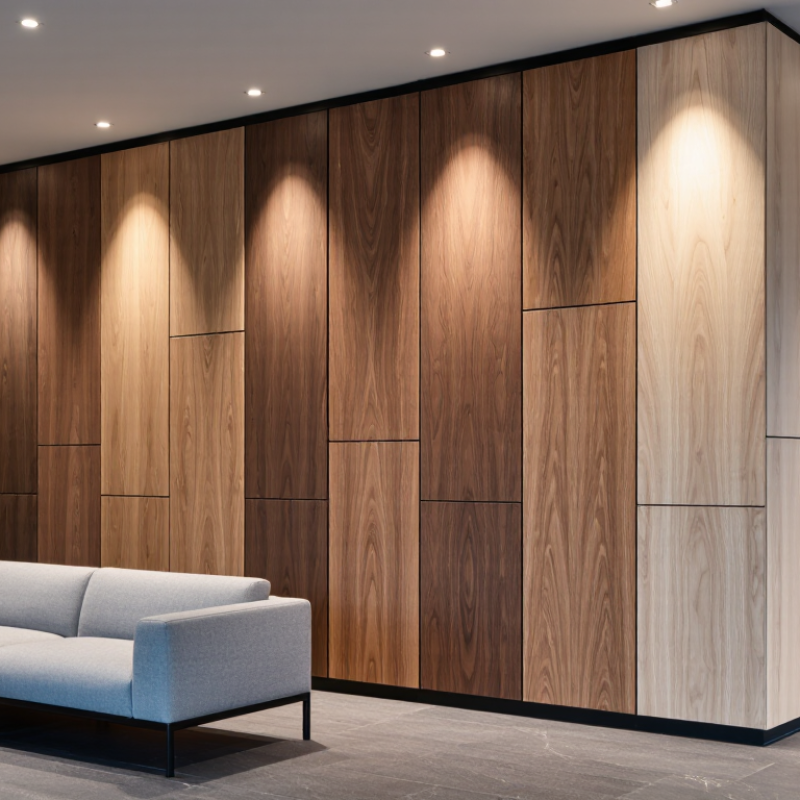
Wood veneer paneling combines a thin natural wood layer with an engineered core. Common species include oak, walnut, ash, maple, and smoked eucalyptus. Each offers a different grain, color, and surface response. Oak suits high-traffic interiors because its grain remains visually stable. Walnut creates a deeper, warmer appearance. Maple looks cleaner but can show handling marks more easily.
Veneer thickness usually ranges from 0.5 to 2 mm. A 0.5 mm veneer supports cost-efficient wall panels and curved applications. Thicker 1–2 mm veneer allows deeper sanding and repairs, but it needs better moisture control. Core selection matters just as much. Plywood offers strength and screw retention. MDF provides a smooth, stable face for painted or veneered surfaces. Particleboard costs less, yet its edges require careful sealing. Blockboard can perform well on larger panels, though movement may vary between suppliers. I would not assume thicker always means better; the installation environment decides that.
Tips: Request a physical sample before approving production. Check veneer matching, core density, formaldehyde documentation, and panel flatness. Measure moisture content on arrival. Small differences can become visible across a long feature wall. For humid rooms, specify sealed edges and a moisture-resistant core. One overlooked detail is back balancing; without it, panels may warp after installation. Suppliers should provide clear tolerances, packing details, and replacement procedures. Mistakes still happen, so inspect several panels rather than trusting one sample.
Supplier Screening: FSC Chain of Custody and E1 Emissions ≤0.124 mg/m³
Choosing modern wood veneer paneling for international projects requires more than attractive grain and stable pricing. Supplier screening should begin with a valid FSC Chain of Custody certificate. Check the certificate number, product scope, site address, and validity date. The supplier should also explain how certified logs, veneers, cores, and finished panels remain traceable through production.
Ask for recent formaldehyde test reports showing E1 emissions at or below 0.124 mg/m³. The report should identify the exact panel construction, thickness, test method, laboratory, and sampling date. Do not accept a generic statement printed on a brochure. Testing conditions matter. So does batch consistency. Compare reports with production samples, especially when veneer, adhesive, or core materials change.
Factory visits can reveal practical details that documents miss. Look for labeled material zones, sealed edge storage, calibrated testing equipment, and clear purchase records. An experienced supplier should answer technical questions without avoiding weak points. I would also request random pre-shipment testing for large orders. It adds cost, but indoor air quality is harder to repair after installation. One limitation remains: a certificate cannot guarantee every future batch. Supply chains shift, and paperwork can lag behind reality. That risk deserves written controls and periodic review.
Global Buying Factors: MOQ, Lead Time, Incoterms, and 20-Foot Container Loads
Top Modern Wood Veneer Paneling Suppliers for Global Buyers
Global purchasing starts with a realistic MOQ, not the lowest advertised number. Suppliers may set different minimums for standard panels, custom stains, and fire-rated cores. Ask whether the MOQ applies per design, thickness, finish, or total order. A trial order of 50 to 100 panels can reveal color variation, edge quality, and packaging weaknesses. It may also cost more per unit. That trade-off is easy to underestimate.
Lead time should include sampling, approval, production, inspection, and loading. Standard orders often require four to eight weeks after deposit and confirmed artwork. Custom veneer matching can extend this period. Request a dated production schedule with clear approval deadlines. I have seen projects delayed because one approved sample was not linked to the purchase order. The paperwork looked complete. It was not.
Incoterms must match the buyer’s logistics experience. FOB can suit experienced importers managing ocean freight and insurance. CIF may simplify freight booking, but destination charges still require careful checking. DAP offers more delivery support, yet taxes and local clearance may remain the buyer’s responsibility. For a 20-foot container, calculate usable volume from panel dimensions, pallets, protective corners, and loading gaps. A practical load may hold about 25 to 28 cubic meters, but the packing plan decides the result. Do not trust a rough estimate. A missed pallet can change the landed cost.
Global Buying Benchmarks for Wood Veneer Panels
The chart presents practical planning benchmarks commonly used in international wood veneer panel sourcing: a starting MOQ of approximately 500 m², a standard production lead time of about 35 days, an estimated 20-foot container capacity of around 650 m², and four commonly negotiated Incoterms: EXW, FOB, CIF, and DAP. Actual figures vary according to panel thickness, packaging, finishing, port congestion, and supplier production schedules.
Supplier Comparison: Price per m², Customization, Testing, and Warranty Terms
Global buyers should compare wood veneer panel suppliers by delivered value, not headline price. Typical quotes range from 35 to 120 USD per m², depending on veneer species, core material, thickness, and order volume. Ask whether sanding, edge treatment, packaging, and freight are included. A cheaper offer may exclude moisture-resistant backing or export-grade crates.
Customization often separates a capable supplier from a basic reseller. Confirm veneer matching, panel dimensions, perforation, curved forms, and finish samples before approval. Request one physical sample with the proposed stain and sheen. Digital images can hide color variation. They often do.
Testing documents should match the project’s risks. Useful records may include formaldehyde emissions, fire performance, moisture resistance, bonding strength, and surface abrasion. Check the test method, laboratory date, and product code. A certificate without batch traceability provides limited protection. This detail is frequently overlooked.
Warranty terms need careful comparison. Look for coverage periods, acceptable tolerances, installation exclusions, and claim procedures. Some suppliers offer five years, while others provide shorter coverage with stronger technical support. Confirm how defects are judged and who pays replacement freight. No comparison is perfect. Veneer is a natural material, so small grain and color differences may remain acceptable. A reliable supplier explains these limits plainly, records approvals, and keeps production samples for future reference.