
Leave Your Message
Choosing a Wpc Fluted Panel should begin with performance, not appearance. Vertical grooves may create a warm, architectural surface, but the core material determines durability, stability, and maintenance. A panel that looks premium can still warp beside a sunny window.
Grand View Research reported that the global wood-plastic composites market was valued at approximately USD 7.10 billion in 2023. It also forecasts continued growth through 2030. These figures describe the wider WPC sector, not fluted panels alone. Still, they show rising interest in hybrid materials for residential, commercial, and outdoor applications. The U.S. Department of Agriculture also identifies wood-plastic composites as products whose performance depends strongly on wood content, polymer type, additives, and processing quality.
Michael Carus, managing director of nova-Institute, offers a useful caution: “WPC is not automatically sustainable; its impact depends on feedstocks, service life, and end-of-life.” That point matters when comparing a Wpc Fluted Panel. Ask whether the wood is responsibly sourced. Check recycled polymer content. Request technical data for water absorption, dimensional movement, fire behavior, and UV resistance. Do not rely on attractive samples alone.
Installation details matter too. Leave the manufacturer’s expansion gap. Protect cut edges. Confirm whether the panel suits bathrooms, façades, ceilings, or only dry interiors. Local climate changes the decision.
There is no universal best panel. A denser board may improve impact resistance, but it can increase weight and cost. A recycled formulation may reduce virgin plastic use, yet show greater color variation. Careful comparison is less exciting than choosing quickly. It is also safer.
How to Choose WPC Fluted Panels for Your Project?
Define your project’s functional and visual requirements before comparing panel colors. A hallway may need impact resistance, easy cleaning, and stable performance under frequent contact. A bedroom may prioritize warmth, acoustic comfort, and softer shadow lines. In humid rooms, check moisture resistance, edge sealing, and ventilation conditions. Do not assume every WPC panel performs equally.
The Grand View Research Wood Plastic Composites Market Report estimates a global market value of about 7.19 billion dollars in 2023. It also projects a 7.4% compound annual growth rate from 2024 to 2030. This growth reflects wider use, but it does not remove the need for project-specific testing. Ask suppliers for fire, moisture, dimensional stability, and surface-wear results. Check the test methods, not only the headline ratings.
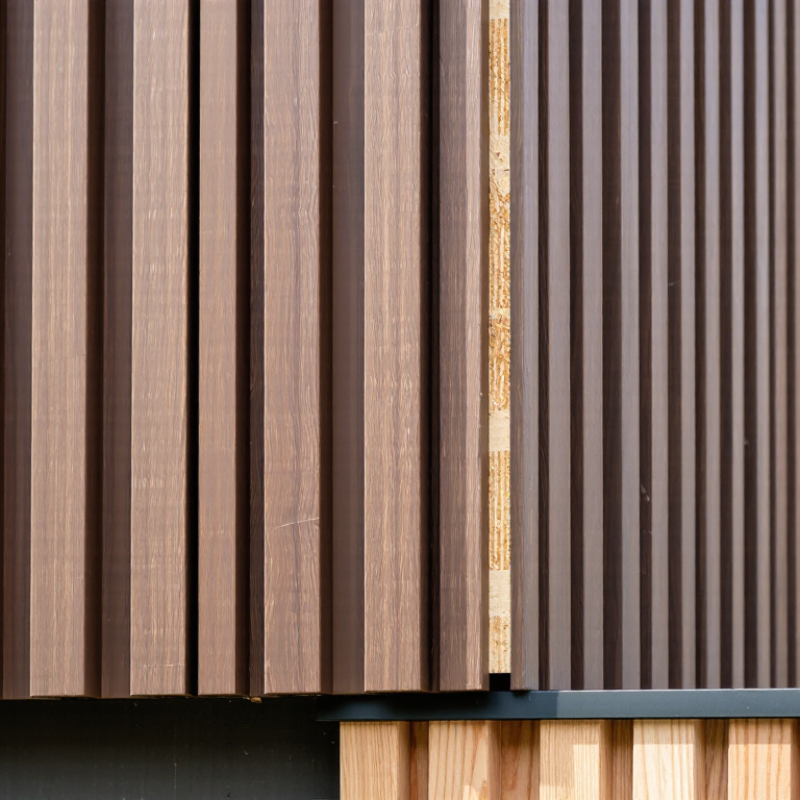
Visual requirements should be measured beside functional ones. Narrow flutes can create a delicate rhythm, while deeper profiles produce stronger shadows and hide minor wall irregularities. In a small room, dark panels may feel heavier than expected. That assumption deserves testing. Use sample boards under the project’s actual lighting, including cool LEDs and daylight. The United Nations Environment Programme reported that buildings consumed about 34% of global energy in 2022. Selecting durable, repairable panels can support longer service life, but recycled content and end-of-life options still require verification. Looks matter. Performance matters more.
| Project Requirement | Key Questions to Define | Recommended WPC Fluted Panel Specifications | Practical Selection Guidance | Suitable Project Applications |
|---|---|---|---|---|
| Indoor or Outdoor Use | Will the panels be installed in a conditioned interior space, a covered exterior area, or an exposed outdoor location? | Interior grade Moisture-resistant UV-stabilized for exterior use | Use interior-grade panels for dry walls and ceilings. For outdoor applications, verify UV resistance, water resistance, temperature tolerance, and the manufacturer’s exterior-use instructions. | Feature walls, covered balconies, soffits, exterior accent walls, sheltered commercial entrances |
| Moisture Exposure | Could the panel contact humidity, condensation, splashing water, or regular cleaning? | Low water absorption Sealed edges Ventilated installation | WPC is generally more moisture-resistant than untreated wood, but it is not automatically waterproof. Protect cut edges, avoid prolonged standing water, and provide drainage or ventilation where required. | Bathrooms outside direct shower zones, kitchens, restaurants, spa reception areas, humid corridors |
| Fire and Building-Code Needs | Does the project require a specific flame-spread, smoke-development, or fire-resistance classification? | Verified fire test report Code-compliant assembly Approved substrate | Do not rely only on the term “fire-resistant.” Confirm the tested classification for the complete wall or ceiling assembly, including the panel, adhesive, framing, substrate, and installation method. | Hotels, healthcare facilities, schools, offices, transport buildings, public interiors |
| Impact and Wear Resistance | Will the surface face luggage, carts, furniture movement, pets, children, or frequent contact? | Dense core Durable surface finish Replaceable sections | Choose a robust surface and install panels over a stable, flat substrate. Fluted profiles can collect dust and may be more difficult to repair if individual ribs are damaged. | Retail stores, hospitality areas, corridors, reception desks, residential living rooms |
| Acoustic Performance | Is the goal to reduce reverberation, improve speech comfort, or block sound transmission between rooms? | Acoustic backing Perforated or grooved design Mineral-wool cavity where needed | Decorative flutes alone do not guarantee sound absorption. For measurable acoustic improvement, use a tested panel system with an acoustic backing or an appropriately designed cavity. | Meeting rooms, restaurants, home theaters, studios, open-plan offices, reception areas |
| Visual Style | Should the wall appear warm and natural, contemporary and linear, or bold and architectural? | Wood-tone finish Solid color Fine or wide flutes | Use narrow flutes for a refined, textured appearance and wider flutes for a stronger architectural effect. Request physical samples because printed color and texture images can differ from the finished panel. | Feature walls, media walls, retail displays, hotel lobbies, restaurants, residential interiors |
| Panel Dimensions and Layout | What wall height, joint pattern, and visual rhythm should the design create? | Standard modular width Vertical or horizontal installation Calculated cutting allowance | Vertical flutes can emphasize ceiling height, while horizontal layouts can make a wall feel wider. Plan around doors, outlets, corners, and full-width visual lines before ordering. | Accent walls, ceiling bands, partitions, columns, retail and hospitality interiors |
| Installation Method | Is the substrate level, dry, structurally sound, and suitable for adhesive, clips, or mechanical fasteners? | Flat substrate Compatible adhesive Mechanical fixing when required | Follow the panel system’s installation instructions. Allow for expansion where specified, use appropriate trims, and avoid installing over damp or unstable surfaces. | Renovations, new construction, suspended ceilings, partition systems, wall refurbishment |
| Cleaning and Maintenance | How often will the surface be cleaned, and will it be exposed to grease, dust, or disinfectants? | Non-abrasive finish Easy-clean surface Compatible cleaning agents | Most finished WPC surfaces can be cleaned with a soft cloth and mild detergent. Avoid abrasive pads, harsh solvents, and excessive water unless the product documentation specifically permits them. | Commercial corridors, restaurants, offices, retail interiors, family homes |
| Color Stability | Must the color remain consistent under daylight, artificial lighting, or exterior exposure? | UV-stabilized formulation Batch consistency Sample approval | Natural-looking finishes may contain intentional shade variation. Approve a physical sample and, for large projects, purchase panels from the same production batch when possible. | Sunlit interiors, covered outdoor areas, commercial façades, large feature walls |
| Sustainability Goals | Does the project require recycled content, responsible material sourcing, or documented environmental information? | Declared recycled content Material documentation Low-waste planning | Ask for verifiable information about wood fiber, polymer content, manufacturing emissions, recyclability, and packaging. Reduce waste by preparing a cutting plan before ordering. | Green-building projects, offices, hospitality interiors, retail fit-outs, residential renovations |
| Budget and Total Cost | Is the priority the lowest purchase price, the fastest installation, or the lowest long-term maintenance cost? | Complete system pricing Trim and accessory allowance Installation labor | Compare the total installed cost, not only the panel price. Include trims, substrate preparation, fasteners or adhesive, cutting waste, transport, and labor. | Residential upgrades, commercial fit-outs, hospitality refurbishments, phased renovation projects |
| Quantity and Waste Control | How many panels are needed after accounting for openings, corners, pattern alignment, and offcuts? | Accurate site measurements Pattern planning Cutting allowance | Measure each wall separately and calculate waste based on the layout. A practical allowance is commonly around 5% to 15%, depending on room complexity and pattern matching. | Multi-wall installations, irregular rooms, angled walls, projects with many openings |
| Long-Term Reliability | What service life, warranty coverage, and replacement support does the project require? | Documented warranty Installation requirements Replacement availability | Review warranty exclusions related to moisture, sunlight, incorrect fixing, structural movement, and cleaning chemicals. Keep spare panels from the approved batch for future repairs. | Permanent residences, offices, hotels, retail premises, institutional buildings |
Selection principle: Choose the WPC fluted panel system only after matching its tested performance, installation requirements, and maintenance needs with the project’s actual environment and design objectives.